%% format               (plain.tex + fichiers de macro) OU (jpv.tex)
%% fichiers de macro    basejpv.tex + columns.tex + illustr.tex
%% sujet                equations, inequations, fractions
%% date                 09-10-97
%% auteur               jp vignault

\exo{\`A partir d'un dessin}

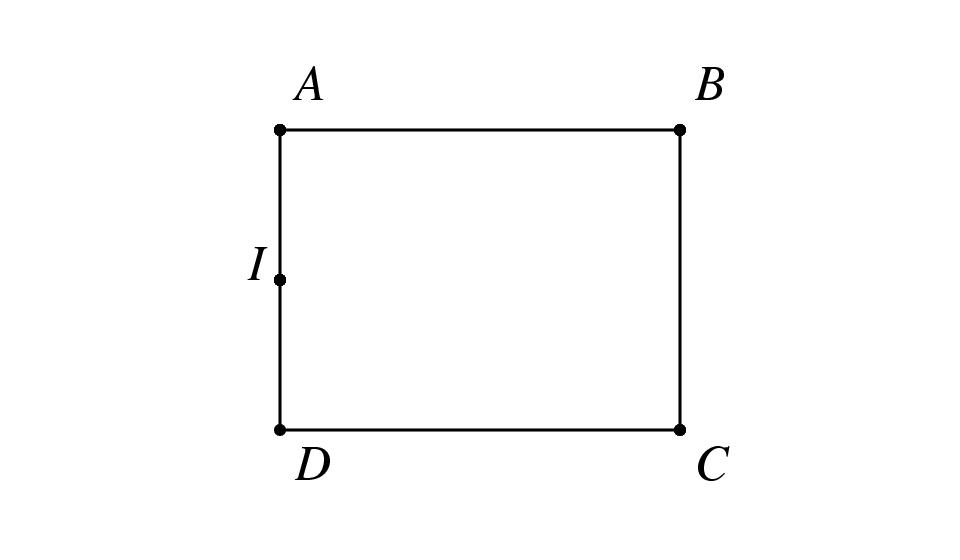
On considère la figure ci-dessous dans le plan rapporté
à un repère orthonormé
$(O, \vec\imath, \vec \jmath\,)$~:
$ABCD$ est un rectangle, $AB=4$, $BC=3$, et $I$ est le milieu du segment $[AD]$.

\def \epspath{%
   $HOME/tex_doc/lycee/database/1ere/sti/geometry/scalaire/}
\epsfxsize = 100mm
$$
   \superboxepsillustrate{scal_014.ps}
$$
Déterminer, en expliquant les calculs, les produits scalaires
suivants~:

\columns 5

\alph\ $\overrightarrow{AB} \cdot \overrightarrow{CD}$

\alph\ $\overrightarrow{AB} \cdot \overrightarrow{CB}$

\alph\ $\overrightarrow{BI} \cdot \overrightarrow{AD}$

\alph\ $\overrightarrow{IB} \cdot \overrightarrow{IC}$

\alph\ $\overrightarrow{CA} \cdot \overrightarrow{DB}$

\endcolumns

\finexo

\corrige{}

\itemalph Comme $\overrightarrow{CD} = - \overrightarrow{AB}$, on a
$$
   \overrightarrow{AB} \cdot \overrightarrow{CD}
      = - \overrightarrow{AB} \cdot \overrightarrow{AB}
      = - \overrightarrow{AB}^2
      = \dresultat{-16}
$$

\itemalph Comme les vecteur $\overrightarrow{AB}$ et
      $\overrightarrow{CB}$ sont orthogonaux, on a
$$
   \dresultat{\overrightarrow{AB} \cdot \overrightarrow{CB} = 0}
$$

\itemalph Comme $\overrightarrow{AD} = \overrightarrow{BC}$, on a
$$
   \overrightarrow{BI} \cdot \overrightarrow{AD}
      = \overrightarrow{BI} \cdot \overrightarrow{BC}
      = \overline {BI'} \times \overline {BC}
$$
où $I'$ est le projeté orthogonal du point $I$ sur la droite
$(BC)$. Le point $I'$ est é\-vi\-dem\-ment le milieu du segment
$[BC]$. D'où
$$
   \overrightarrow{BI} \cdot \overrightarrow{AD}
      = 3 \times {3 \over 2}
      \qquad {\rm soit} \qquad
   \dresultat {\overrightarrow{BI} \cdot \overrightarrow{AD}
   = {9 \over 2}}
$$

\itemalph Pour cette question, il est difficile d'utiliser le théorème
      de projection. On va donc décomposer. Deux solutions possibles~:
$$\eqalign{
      \bullet \qquad
      \overrightarrow{IB} \cdot \overrightarrow{IC}
      &= \overrightarrow{IB} \cdot \left( \overrightarrow {ID} +
\overrightarrow {DC}\right)
\cr
   &= \overrightarrow{IB} \cdot \overrightarrow {ID} +
   \overrightarrow{IB} \cdot \overrightarrow {DC}
\cr
   &= \overline {IA} \times \overline {ID} + \overline {DC} \times
   \overline {DC}
   = -{3\over 2} \times {3\over 2} + 16 = \dresultat {{55 \over 4}}
\cr
      \bullet \qquad
      \overrightarrow{IB} \cdot \overrightarrow{IC}
      &= (\overrightarrow{IA} + \overrightarrow{AB}) \cdot
      (\overrightarrow{ID} + \overrightarrow{DC})
\cr
      &= \underbrace {\overrightarrow{IA} . \overrightarrow{ID} }_{ -IA^2}
      + \underbrace {\overrightarrow{IA} . \overrightarrow{DC} }_{ 0}
      + \underbrace {\overrightarrow{AB} . \overrightarrow{ID} }_{ 0}
      + \underbrace {\overrightarrow{AB} . \overrightarrow{DC} }_{ AB^2}
\cr
      &= -{9 \over 4} + 16 = \dresultat {{55 \over 4}}
}$$

\itemalph Là encore, il faut utiliser la décomposition. Deux exemples
de décompositions possibles~:
$$
\eqalign {
   \bullet \qquad
   \overrightarrow {CA} \cdot \overrightarrow {DB}
      &= \overrightarrow {CA} \cdot \left( \overrightarrow {DC} +
\overrightarrow {CB} \right)
\cr
      &= \overrightarrow {CA} \cdot \overrightarrow {DC} +
      \overrightarrow {CA} \cdot \overrightarrow {CB}
\cr
      &= \overline {CD} \times \overline {DC} + \overline {CB} \times
      \overline {CB}
    = - 16 + 9 = \dresultat{- 7}
\cr
   \bullet \qquad
   \overrightarrow{CA} \cdot \overrightarrow{DB}
      &= (\overrightarrow{CD} + \overrightarrow{DA}) \cdot
      (\overrightarrow{DC} + \overrightarrow{CB})
\cr
      &= \underbrace {\overrightarrow{CD} . \overrightarrow{DC} }_{ -DC^2}
      + \underbrace {\overrightarrow{CD} . \overrightarrow{CB} }_{ 0}
      + \underbrace {\overrightarrow{DA} . \overrightarrow{DC} }_{ 0}
      + \underbrace {\overrightarrow{DA} . \overrightarrow{CB} }_{ DA^2}
\cr
      &= - 16 + 9 = \dresultat{- 7}
\cr }
$$

\fincorrige